Free shipping
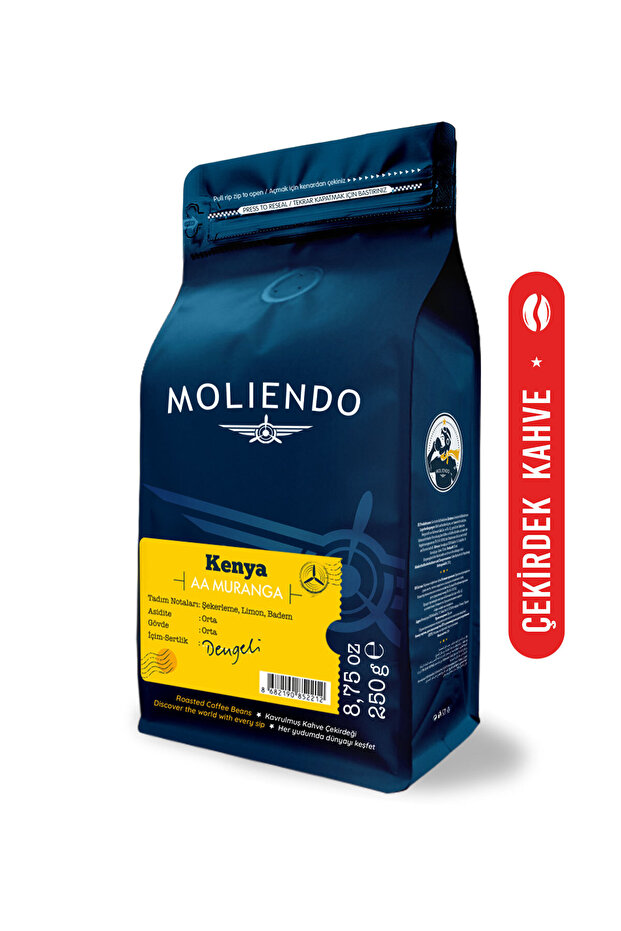


Moliendo Kenya Aa Muranga Local Coffee (Core Coffee) 250 g

Lowest price in 7 days
Campaign Price
At checkout
28.73 AED
101.97 AED
Grinding Type: Whole Beans
Free shipping
Delivery address

Select your address, find out the delivery date!
International delivery
Trendyol's commitments
Return unavailablePlease note that items in this category cannot be returned due to health protection, hygiene and/or legislation.
Payment methods




Highlighted features:
Moliendo Finest Coffee Kenya Aa Muranga Local Coffee (Core Coffee) 250 g features
Origin
KE
Weight
250 g

Kahvecom

9.4
326.5K followers
Seller information
Similar items




 ® Safari Symphony ™ 250 g Kenya Local Filter Coffee


 Trendyol Plus Exclusive











Shoppers also viewed





Moliendo Finest Coffee Kenya Aa Muranga Local Coffee (Core Coffee) 250 g reviews
37 ratings
11 reviews

Product details

Product description
Crown your coffee pleasure with the fresh coffee moliendo packaged at the time of order
Start exploring the world in every sip with moliendo coffees, fresh roasted, brought from 70 different regions
Nguku ab thanga, which belongs to the central kenya region
These cores from machining station are from 700 different small manufacturers' crops
A coffee with a soft and pleasant drink, in which the almond taste is felt dominant, accompanied by a hint of lemon
Core type: sl28, sl34, ruiru 11 tasting notes: candy, lemon, almond, aroma (smell): candy, lemon, almond body: medium altitude of growth: 1400m harvest period: november
Range processing process: washed acidity:medium quantity: 250 g
Additional info
- Sold by .
- The selling price on Trendyol already includes the export-related costs.
- A maximum of 5 units of this product can be ordered. Trendyol reserves the right to cancel orders over 5 units.
- Barcode No: 8682190852212
- Origin: KE
Moliendo Finest Coffee Kenya Aa Muranga Local Coffee (Core Coffee) 250 g features
Origin
KE
Weight
250 g
Safety information
Product safety information
Product description
Experience the freshness in every sip with moliendo, roasted weekly and packaged to order. Discover the unique flavor profiles of the world with moliendo coffees, crafted from the finest beans sourced from 70 distinct regions. These beans, sourced from the nguku ab thanga-ini processing station in central kenya, are a blend of crops from 700 different smallholder farmers. A coffee with a dominant almond flavor, complemented by a hint of lemon, offering a smooth and enjoyable drinking experience. Tasting notes: candy, lemon, almond acidity: medium body: balanced flavor profile: the almond flavor is quite prominent in the initial sip, giving way to a noticeable lemon taste after two or three sips, ultimately creating a lingering, cohesive flavor. You want to take the next sip before the taste on the palate goes and maintain that flavor. It has a very creamy and soft drink, a smooth finish. After the sip, a pleasant trail remains in the front of the tongue, in the back of the palate. Kenya is a neighboring country of ethiopia, the homeland of coffee. It is located in the south-west of the african continent and also has fertile soils necessary for the production of coffee. Despite this, coffee production in kenya begins almost 1000 years later than in ethiopia. We know that coffee was first discovered in ethiopia in the 850s, and its commercial development was between 1000-1100. Coffee arrived in kenya in 1893, during the french colonial period. Therefore, the types of coffee grown in kenya are quite different compared to ethiopia. In ethiopia, coffee production focuses on typica arabica beans and their thousands of variations, while in kenya, bourbon varieties are the primary focus for coffee production. When we say bourbon, we should specifically remind here that the subject should not be confused with the production of whiskey. Bourbon coffee beans are named after the bourbon islands (now known as the réunion islands), where they were first discovered. during the colonial period, the bourbon variety was cultivated in many equatorial countries under french rule. Today, about 70% of kenya's coffee production is supplied by small producers and farms. The kenyan government, which also focuses on women ' s workforce, supports women in working in the coffee sector. Detailed information: when you examine the core varieties that make up this coffee blend, you'll notice they are sl28, sl34, and ruiru 11. Although kenya boasts coffee-friendly soil, its bourbon-derived beans have historically struggled with yield efficiency over time. As rust disease, the enemy of coffee trees, begins to occur and increase, coffee improvement studies are started. Through research conducted by scott agricultural laboratories (now known as national agricultural laboratories, narl), the genetics of bourbon-type coffee are being modified to enhance disease resistance and improve yield. These types of seeds are named with a sl (scott labs) prefix and a code, rather than bourbon, due to genetic modification. Sl-28 is a variety of coffee bean originally developed in tanganyika (now tanzania) and production began in kenya in 1931. Sl-28 offers a remarkably high flavor profile, but despite its lower yield, it's a disease-resistant variety. Produced by processing the genes of mocha and yemen kernels of the bourbon type. Sl-34 is a mutation produced from french plantings in the loresho production area in kenya kabete. It is a plant with wide leaves with bronze tips. It is a type with high efficiency, resistant to both heavy rainfall and variable weather conditions. Ruiru11 is a type produced later than sl-34 and sl28. The work that started in the 1970s was completed in 1985. The first tests of ruiru were between the varieties hibrido de timor and rume sudan, while in subsequent generations the genes sl28 and sl34 are also added through backcrossing to ensure high quality of tasting, thus producing a variety with a fairly resistant structure to the disease of the berry and rust. A coffee variety that enhances diversity for farmers by enabling early planting and harvesting.
Collections you might like
Moliendo Finest Coffee - Ground & Bean Coffee


Moliendo Finest Coffee - Best Sellers